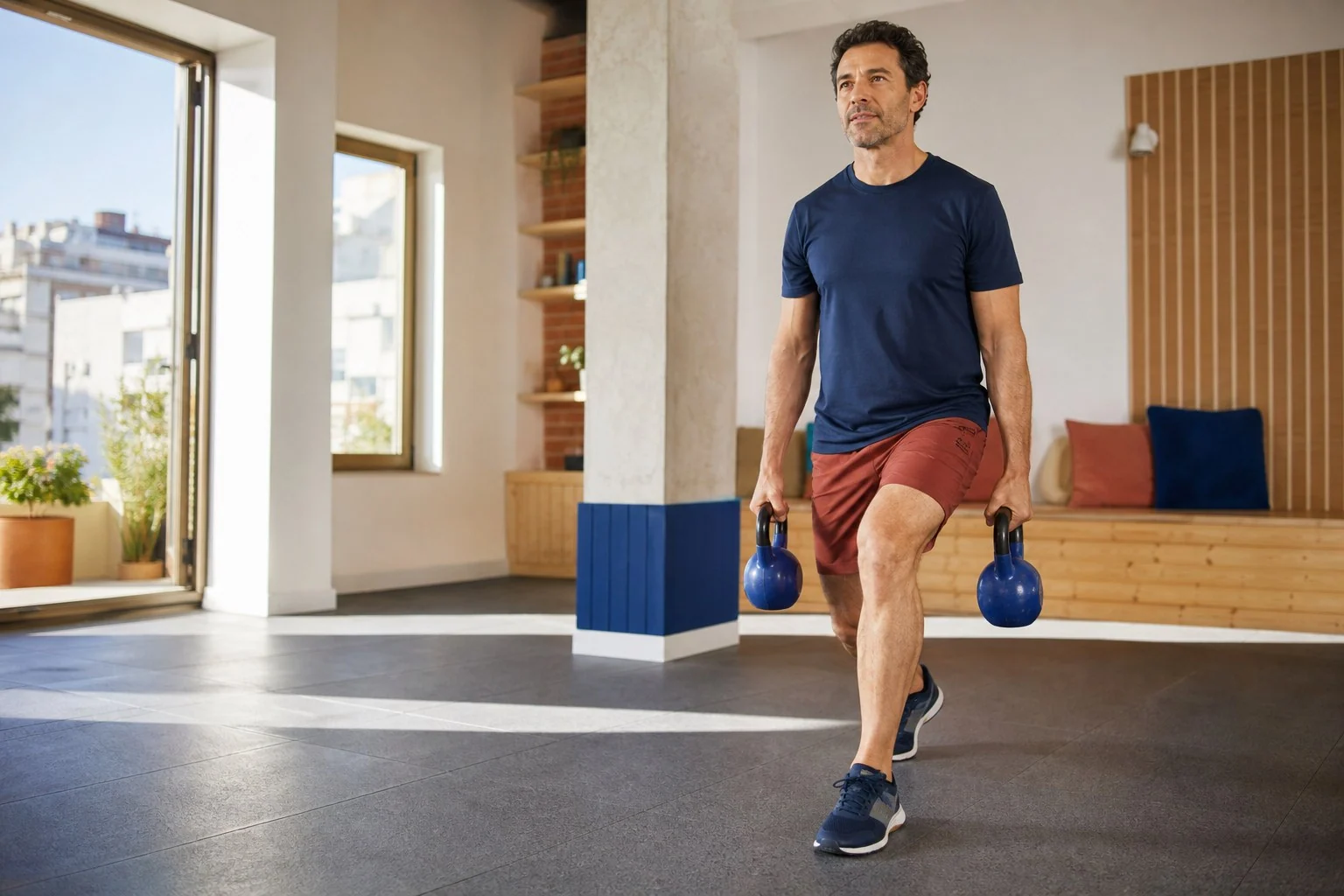
Climbing a hill, keeping up with someone on a walk or finishing a hike with energy depend partly on your aerobic capacity. VO₂ max describes the greatest amount of oxygen your body can use during intense effort. That makes it relevant beyond competitive sport too.
From air to movement
To sustain the effort, several systems work together. Breathing faster is just one part: oxygen has to reach the tissues and use to get energy. Cardiorespiratory capacity reflects this coordination.
The process, at a glance
A path that ends in the muscle
- Entry
Lungs
Oxygen from the air passes into the blood.
- Transport
Heart and circulation
Blood carries oxygen to the tissues.
- Use
Muscles
The cells use oxygen to produce energy during the effort.
Why is it discussed so often in relation to longevity?
Good cardiorespiratory fitness is consistently associated with more longevity and better health. A 2024 review bringing together 26 systematic reviews found mortality was 11 to 17 % lower for each MET higher fitness level. This is a powerful reason to make exercise part of your week.
Aerobic capacity · Evidence
Aerobic capacity counts
lower relative mortality associated with
a fitness level 1 MET higher
Benefits can be felt now too: climbing a hill with less fatigue, recovering sooner or enjoying a hike. This capacity can be trained. You don't have to be a competition athlete to start improving it.
Understand the figure before comparing it
The usual thing is to express it in millilitres of oxygen per kilogram of body weight per minute (ml/kg/min). It can also be expressed in litres per minute. The first measure includes body weight, so a weight change can alter the relative figure without all of that change resulting from training adaptation.
Age, sex, the test protocol and exercise type influence interpretation. Comparing yourself with an arbitrary table or another person's watch can mislead. It is more useful to understand how the figure was obtained and follow changes under comparable conditions.
The MET uses resting oxygen consumption as a reference. Conventionally, one MET is approximately 3,5 ml/kg/min. It expresses exercise capacity on a shared scale: greater capacity provides more reserve for daily activities.
Measurement and estimation are not the same
To understand better
Measuring and estimating answer different questions
- Direct measurement
Test with gas analysis
Analyzes the exchange of oxygen and carbon dioxide during the effort. The professional interprets the result and if a maximum effort or peak value was achieved.
- Estimate
Watch or field test
Uses variables such as pace, heart rate and personal data. It may indicate a trend, but depends on the algorithm and does not replace clinical assessment.
Train base, then adjust intensity
Brisk walking, cycling, swimming and dancing all develop aerobic fitness. The right activity is one you can repeat and adapt. If you are currently inactive, walking more comfortably and more often may be the first step before trying to run.
To understand better
A simple guide: how easily you can talk
- Moderate intensity
Talk, not sing
The breath is accelerating, but you can have a conversation.
- Vigorous intensity
A few words
You need breaks to breathe. It demands more effort and recovery.
As a general reference, the physical activity guides propose for adults 150–300 minutes of moderate activity per week, or 75–150 minutes of vigorous activity, or an equivalent combination, alongside muscle-strengthening activity. These are goals to work towards according to your circumstances, not a requirement for the first week.
A progression you can sustain
The process, at a glance
Start → Consolidate → Progress
Find your starting point
Choose an activity and a duration that you can repeat without ending up exhausted. Book specific moments in your week.
Make it more common.
Gradually increase frequency or duration, while monitoring your recovery. Change one variable at a time.
Adjust the stimulus
Once you have a base, add changes of pace or adapted intervals to keep improving. Keep some comfortable sessions too, along with recovery.
The intervals alternate periods of greater effort and recovery. If you already walk with comfort, you can enter slightly faster sections and then come back at an easy pace. Those who already train can work more demanding intervals, adjusted to their experience. Progression turns effort into improvement.
The base and the intervals are complemented
Continuous sessions at a comfortable pace help build activity time and endurance. Changes of pace add a more intense stimulus. Combining both, when your fitness allows, helps develop aerobic capacity without turning every outing into a competition.
Among the known protocols is the 4 × 4: four four-minute high effort intervals, separated by recovery. This is an option for people prepared for that workload. To begin, walks with brisk sections or gentle hills offer a more accessible progression.
Step by step
From one week to the next
First, frequency
Find several moments to walk, pedal or swim at an intensity you can repeat.
After, duration
Add some time when you recover well and the tour becomes more comfortable.
Then, variety
Include brisk sections, hills or intervals, alternating with easy sessions.
The most useful sign can be daily: make the same tour with less effort or enjoy an activity you previously avoided.
Record the route, duration, perceived effort and recovery. A one-off drop in your watch's estimate after poor sleep or different training conditions does not define progress. If you develop chest pain, fainting or disproportionate difficulty breathing during exercise, stop and seek medical attention.
Train for the life you want to maintain
Choose an activity you enjoy and a motivating challenge. If you have cardiovascular disease, symptoms or concerns before intense exercise, an assessment can help determine an appropriate workload. Aerobic fitness and strength complement each other: one sustains effort; the other helps you lift, carry and move with control.